Meniscus Root Tear (Posterior Meniscal Root Tear) and Root Repair
If your MRI report mentions a posterior root tear of the medial meniscus, meniscal extrusion or a ghost sign, this page explains what those terms mean, how much they matter and what can be done. A meniscal root tear is a tear at the point where the meniscus attaches to bone. It matters more than most meniscal tears because it stops the whole meniscus from carrying load, and its urgency is not always recognised.
What the meniscal roots do
Each knee has two menisci, C-shaped pads of tough, rubbery cartilage between the thigh bone (femur) and the shin bone (tibia), one on the inner (medial) side and one on the outer (lateral) side. Each is fixed to the tibia at its front and back ends. These fixing points are the roots.
Under load, the femur tries to squeeze the wedge-shaped meniscus outwards. Because both ends are anchored, the meniscus tightens around its circumference instead, like a hoop around a barrel, and spreads the load across the joint cartilage. This is hoop stress, and it works only while the roots hold.
Why a root tear matters
When a root tears, the anchor is lost. The meniscus can no longer hold hoop tension and tends to be pushed outwards from between the bones (the “extrusion” on MRI reports). It is still in the knee but no longer spreading the load.
The classic laboratory study loaded nine donor knees before and after cutting the posterior root of the medial meniscus. Peak contact pressure on the inner side of the knee rose by 25%, equivalent to removal of the whole medial meniscus. Repairing the root returned it to normal.1
Who gets a root tear
There are two typical patterns. The first is a tear of the posterior root of the medial meniscus in middle age: across 28 studies of root repair (994 patients), the mean age was 57 and 83% were women.2 The meniscus has often been weakened by age-related wear, and the tear can follow a squat, a twist or a seemingly minor injury. Some people recall no injury at all.3
The second is a tear of the posterior root of the lateral meniscus sustained with a rupture of the anterior cruciate ligament (ACL). In a French series of 3,956 ACL reconstructions, a lateral root tear was found and repaired in 262 patients (6.6%).4
Symptoms, and why root tears are missed
Symptoms that may suggest a root tear include:
- Sharp pain at the back and inner (or back and outer) side of the knee after a squat or twist
- Recurrent swelling with weight-bearing
- A feeling the knee has suddenly “aged”, becoming much less tolerant of walking or standing
Some people feel a single painful pop. In a Korean study of 936 people having keyhole surgery for a medial meniscal tear, 96.5% of those who recalled a pop had a root tear, but only 35% of those with a root tear had felt one.5
A root tear can be missed: most people feel no pop, there may be no remembered injury,3 and for lateral root tears in ACL-injured knees, imaging before surgery is unreliable.4
How a root tear is diagnosed
On examination I check joint line tenderness, swelling and range of motion, and perform meniscal provocation tests, but a root tear is diagnosed on MRI.3 The terms a radiologist may use are:6
- Ghost sign: on the side-on (sagittal) images the root appears to have vanished, with fluid in its place.
- Cleft sign (or truncation sign): on the front-on (coronal) images there is a vertical gap through the root.
- Radial tear sign: on the images looking down on the knee (axial), a gap runs across the meniscus at the root.
- Meniscal extrusion: the meniscus bulges out beyond the edge of the tibia; 3 mm or more is classed as major.7
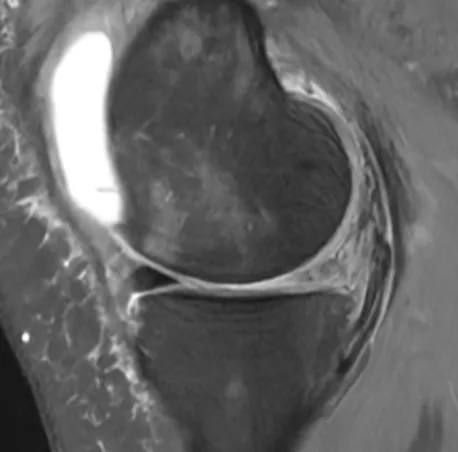
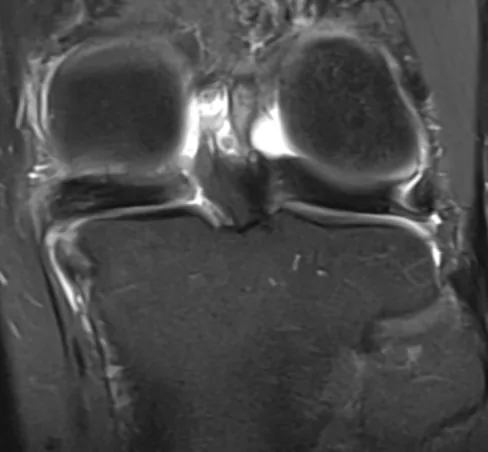
In a 2026 meta-analysis (1,430 patients), the ghost and cleft signs each detected at least 80% of root tears.6 Extrusion is less decisive: in a pooled analysis of 7,882 knees, major extrusion was 3.45 times more likely with a root tear than with other meniscal tears, and 3.86 times more likely in knees with osteoarthritis than in those without.7
Weight-bearing X-rays show how much joint space is left under load and whether arthritis is established, and long-leg alignment X-rays, taken standing, show whether the leg is bow-legged. Both affect whether repair is worthwhile.
What happens without repair
Two studies show what can happen when a medial root tear is treated without surgery. In a US series of 52 patients, 25 of the 47 traced at a mean of 14 years (53%) had had a knee replacement.8 In a Korean study of 94 patients followed for a mean of 46 months, 12 (13%) had a knee replacement, the earliest at 8 months, and 34 (36%) showed worsening arthritis on X-ray. Those whose first MRI showed a subchondral insufficiency fracture, a stress fracture in the bone just beneath the cartilage, were about four times as likely to go on to a replacement.9
Neither study had a comparison group, and not every knee deteriorates. But the decline can be quick: many patients who sustain a root tear are at risk of rapid cartilage damage, to the extent that a knee replacement could be needed within 6 to 12 months of the injury.
Treatment options
Partial meniscectomy (trimming the torn part of the meniscus) is almost never indicated for a root tear, as it has been shown to often be worse than no treatment.10
Non-operative care
Non-operative care means physiotherapy, activity modification, anti-inflammatory measures and weight management where relevant. It does not reattach the root, but it is the advised approach when osteoarthritis is already advanced.3 For a root tear causing no symptoms in a knee with only mild wear, an international panel of specialists could not agree on whether to operate.3
Root repair
Root repair is keyhole surgery that reattaches the root to bone. In a transtibial pull-out repair, stitches passed through the torn root are drawn down a narrow tunnel drilled through the tibia and fixed to the bone. In a suture anchor repair, the stitches are held by a small anchor set into the bone at the root’s attachment, with no tunnel. A 2025 international consensus of 56 specialists recommended early pull-out repair for a symptomatic medial root tear in a knee without advanced osteoarthritis.3
I consider root repair when a root tear is causing significant symptoms and the knee is suitable, meaning the cartilage condition and alignment support a good outcome. I offer rapid assessment and treatment for root tears because the window of opportunity for repair is often narrow.
Realignment osteotomy
In a bow-legged (varus) knee the inner side, where the medial root sits, carries more of the load. Varus of more than 5 degrees was associated with a worse result from root repair in all three studies that examined it,11 and the 2025 consensus was that a high tibial osteotomy may be considered at the time of repair when varus is significant.3 Correcting alignment at the same time protects the repair; without it, the forces that damaged the knee in the first place will continue to overload it.
What repair achieves, and what it does not
Symptoms and function improve: in the review of 28 studies, knee scores were better at final follow-up in every study.2 The structural results are less consistent. Complete healing of the root was reported in anything from 21.5% to 85.7% of pull-out repairs, and neither technique reliably brings an extruded meniscus back into position.12 Arthritis may be slowed but is not stopped: in the 11 studies with X-ray follow-up, 49% of patients had worsened by at least one grade at a mean of 4 years.2
Compared with trimming, repair did better over 10 years in a Korean study: 8 of 37 repaired knees (22%) had been replaced, against 10 of 18 (56%) after partial meniscectomy.13 This was a cohort study, not a randomised trial, so differences between the groups at the outset may explain part of the gap.
Who is less likely to benefit from repair
In a systematic review of five studies, two findings before surgery were linked with a poorer result: high-grade cartilage damage (Outerbridge grade 3 or above) and varus of more than 5 degrees. Older age was associated with a worse outcome in only one of the five, and body mass index in none of three.11
Recovery after root repair
Recovery takes longer than after trimming, because the repair needs a protective early phase to allow healing. Expect crutches, no weight through the leg at first and a brace to restrict early range of motion. Active jobs, running and pivoting sport come later. The 2025 consensus regarded limited weight-bearing and range of motion after repair as essential.3
My rehabilitation protocol in outline
A root repair is protected for longer than the standard repair in my protocol. What follows is a general guide: the plan for your knee is set out in the operation note and adjusted by me and your physiotherapist. The time bands are minimum periods, and you move on only when the criteria for the next stage are also met.
- Crutches: no weight through the operated leg for 6 to 8 weeks, on two crutches, with the exact period specified in the operation note (after a standard repair, partial weight-bearing begins at 2 weeks). Weight-bearing is then built up, and the crutches are put aside once you can walk without a limp.
- Brace: a brace holds the knee straight for the first 2 weeks. Bending exercises then begin and build gradually to 90 degrees by 6 weeks. The brace is worn for at least 6 weeks.
- Early weeks: standing and walking are limited to keep swelling down, and I generally suggest ice and compression to help control it.
- Restrictions: no loaded bending beyond 90 degrees (a deep squat, for example) and no twisting under load for at least 16 weeks, because that is when the repair is most vulnerable. Deep squatting and kneeling are reintroduced last, and only if pain-free.
- Driving: only once you are out of the brace and fully weight-bearing, with enough movement, control and reaction time, which is later than the 6 to 8 weeks typical after a standard repair. A right knee takes longer than a left.
- From 12 weeks: a static bike, once the knee bends comfortably beyond 110 degrees, and swimming (front crawl or backstroke). Road cycling and breaststroke wait until 16 weeks.
- Jogging: from 4 months at the earliest, once the knee is free of swelling, moves fully and has no joint-line pain or catching on loaded bending, you walk without a limp, single-leg control is good and thigh muscle (quadriceps) strength is at least 80% of that in the other leg.
- Contact and pivoting sport: not before 6 months, and on stricter criteria that include quadriceps and hamstring strength of at least 90% of that in the other leg and symmetrical hop tests.
When a root repair is done at the same operation as an ACL reconstruction, I use my ACL protocol with the root repair restrictions added: typically no weight, or toe-touch weight only, in a brace for 6 to 8 weeks, as the operation note specifies. Return to sport is governed by whichever of the two is later. My page on return to sport after ligament surgery describes how rehabilitation is staged and how readiness for sport is tested, with more for athletes.
I plan rehabilitation around your tear type, procedure, and goals, with clear milestones rather than a fixed calendar.
Risks of surgery
I measured the risks of keyhole meniscal surgery in a study of 699,965 partial meniscectomies in England. A serious complication within 90 days followed about 1 in 315 operations (0.32%), including infection needing further surgery (about 1 in 740) and a blood clot in the lung (about 1 in 1,280).14 That study was of trimming, not root repair, so the figures show the scale of risk, not a direct estimate.
Other risks are non-healing or re-tear of the repair,12 stiffness, swelling or ongoing pain, and further surgery in the future, particularly if arthritis progresses.
Frequently asked questions
What is a meniscal root tear and why does it matter?
A root tear is a tear at the meniscus attachment point. It can dramatically reduce the meniscus's ability to distribute load, increasing stress on cartilage. In suitable knees, root repair can help restore function and protect the joint. I treat these with some urgency because the risk of rapid cartilage deterioration is real.
What do 'ghost sign' and 'meniscal extrusion' mean on my MRI report?
The ghost sign means that on the side-on MRI images the meniscal root appears to have vanished, with fluid in its place. Meniscal extrusion means the meniscus is bulging out beyond the edge of the shin bone; 3 mm or more is classed as major. Extrusion is also more likely in arthritic knees, so it does not prove a root tear by itself.
Does a meniscal root tear always need surgery?
No. Where osteoarthritis is already advanced, an international consensus of specialists advises non-operative treatment. For a painful medial root tear in a knee without advanced osteoarthritis, the same consensus recommended early repair. I consider repair when the tear is causing significant symptoms and the cartilage condition and alignment support a good outcome.
What happens if a meniscal root tear is not repaired?
Arthritis progresses in many knees, though not all. In a US series, 25 of 47 patients treated without surgery (53%) had had a knee replacement at a mean of 14 years. In a Korean study of 94 patients followed for a mean of 46 months, 13% had a knee replacement and 36% showed worsening arthritis on X-ray.
How long does recovery take after meniscal root repair?
Longer than after trimming, and the early restrictions are stricter than after a standard meniscal repair. In my protocol, no weight is taken through the leg for 6 to 8 weeks after a root repair. A brace holds the knee straight for the first 2 weeks, and bending then builds gradually to 90 degrees by 6 weeks. Loaded bending beyond 90 degrees and twisting are avoided for at least 16 weeks. Jogging is from 4 months at the earliest and contact or pivoting sport from 6 months, each only once the criteria for it are met. I plan rehabilitation around clear milestones rather than a fixed calendar.
Assessment in Bristol
I see patients at two private hospitals in Bristol: Nuffield Health Bristol Hospital (The Chesterfield) in Clifton and Spire Bristol Hospital in Redland. Appointments can be made through the contact page, and clinic details are on the locations page.
Related knee topics
References
- Allaire R, et al. Biomechanical consequences of a tear of the posterior root of the medial meniscus. Similar to total meniscectomy. Journal of Bone and Joint Surgery (American Volume). 2008. PubMed
- Chang PS, et al. Midterm Outcomes of Posterior Medial Meniscus Root Tear Repair: A Systematic Review. American Journal of Sports Medicine. 2022. PubMed
- Chahla J, et al. International Delphi Consensus on Medial Meniscal Root Tears Shows High Agreement on Diagnosis, Treatment, and Rehabilitation but Lack of Agreement on Treatment of Asymptomatic Tears. Arthroscopy. 2025. PubMed
- Praz C, et al. Risk Factors for Lateral Meniscus Posterior Root Tears in the Anterior Cruciate Ligament-Injured Knee: An Epidemiological Analysis of 3956 Patients From the SANTI Study Group. American Journal of Sports Medicine. 2019. PubMed
- Bae JH, et al. Predictive value of painful popping for a posterior root tear of the medial meniscus in middle-aged to older Asian patients. Arthroscopy. 2013. PubMed
- Meng C, et al. Evaluating the diagnostic performance of MRI-based signs for identification of meniscus posterior root tears: a systematic review and meta-analysis. Journal of Orthopaedic Surgery and Research. 2026. PubMed
- Fong FJY, Ong BWL, Lee YHD. Medial Meniscal Extrusion in Patients With Medial Meniscus Root Tears: A Systematic Review and Meta-analysis. Orthopaedic Journal of Sports Medicine. 2023. PubMed
- Krych AJ, et al. Nonoperative Management of Degenerative Medial Meniscus Posterior Root Tears: Poor Outcomes at a Minimum 10-Year Follow-up. American Journal of Sports Medicine. 2023. PubMed
- Choi BS, et al. Subchondral insufficiency fracture is a predictive factor of osteoarthritis progression and conversion to arthroplasty in non-surgically treated medial meniscus root tear. Knee Surgery, Sports Traumatology, Arthroscopy. 2023. PubMed
- Bernard CD, et al. Medial Meniscus Posterior Root Tear Treatment: A Matched Cohort Comparison of Nonoperative Management, Partial Meniscectomy, and Repair. American Journal of Sports Medicine. 2020. PubMed
- Jiang EX, et al. Clinical factors associated with successful meniscal root repairs: A systematic review. The Knee. 2019. PubMed
- Vosoughi F, et al. All-Inside Medial Meniscus Root Repair Improves Function With Results Comparable to Tibial Pullout Method, but Both Methods Fail to Correct Extrusion: A Systematic Review of Clinical and Biomechanical Studies. Arthroscopy. 2026. PubMed
- Chung KS, et al. Root Repair Versus Partial Meniscectomy for Medial Meniscus Posterior Root Tears: Comparison of Long-term Survivorship and Clinical Outcomes at Minimum 10-Year Follow-up. American Journal of Sports Medicine. 2020. PubMed
- Abram SGF, et al. Adverse outcomes after arthroscopic partial meniscectomy: a study of 700 000 procedures in the national Hospital Episode Statistics database for England. The Lancet. 2018. PubMed